Hello World!
Hello, I’m Piyush Dahal, a Ph.D. student in the Department of Civil and Environmental Engineering at Florida State University. I have a background in climate and water‐systems research, and my work focuses on hydroclimatic extremes.
Advancing Hydroclimatic Resilience Through Research & Modeling
Combining statistical and machine-learning approaches with geospatial analysis to understand, predict, and mitigate water-related extremes.
Hydroclimatic Extreme Characterization
Quantify floods, droughts, and other extremes using historical observations and climate-model data.
Geospatial Data Integration & Processing
Streamline large-scale data workflows to produce high‐resolution spatial and temporal analyses.
End-User Application Development
Design and deploy interactive web apps to deliver real-time data and decision-support tools directly to water managers and community stakeholders.
Project Leadership & Collaborative Science
Coordinate interdisciplinary research projects with universities, agencies, and NGOs; communicate complex findings through publications, workshops, and stakeholder engagement.
Science Communication
Translate complex hydroclimatic research into actionable insights for policymakers, practitioners, and the public
Climate Impact & Vulnerability Assessment
Assess climate-change impacts on agriculture and urban water systems; design adaptation strategies in Himalayan and U.S. contexts.
Scholarly Showcase
A curated selection of projects and publications highlighting my work in hydroclimatic extremes and water-resource resilience.
Selected publications
- A ‘Nuclear Bomb’ or Just ‘a Joke’? Groundwater Models May Help Communicate Nuanced Risks to the Great Salt Lake. Water, 2024
- Historical Trend and Future Projection of Extreme Precipitation in Nepal from High-Resolution CMIP6 Data. Severe Storms, 2025
- Modeling the future impacts of climate change on water availability in the Karnali River Basin of Nepal Himalaya. Environmental Research, 2020


Google Earth Engine Apps
Recent Achievement
I recently had the pleasure of presenting my poster, “How Antecedent Soil Moisture and Rainfall Shape Flood Severity and Dynamics?”, at the FAMU-FSU College of Engineering poster session. In this study, we evaluated flood events in the 400 km² Swannanoa watershed (North Carolina) from 2015–2023, extracting key attributes—peak, volume, duration, and flashiness—and used Bayesian networks and machine-learning techniques to untangle the relative roles of pre-event soil moisture versus rainfall characteristics .
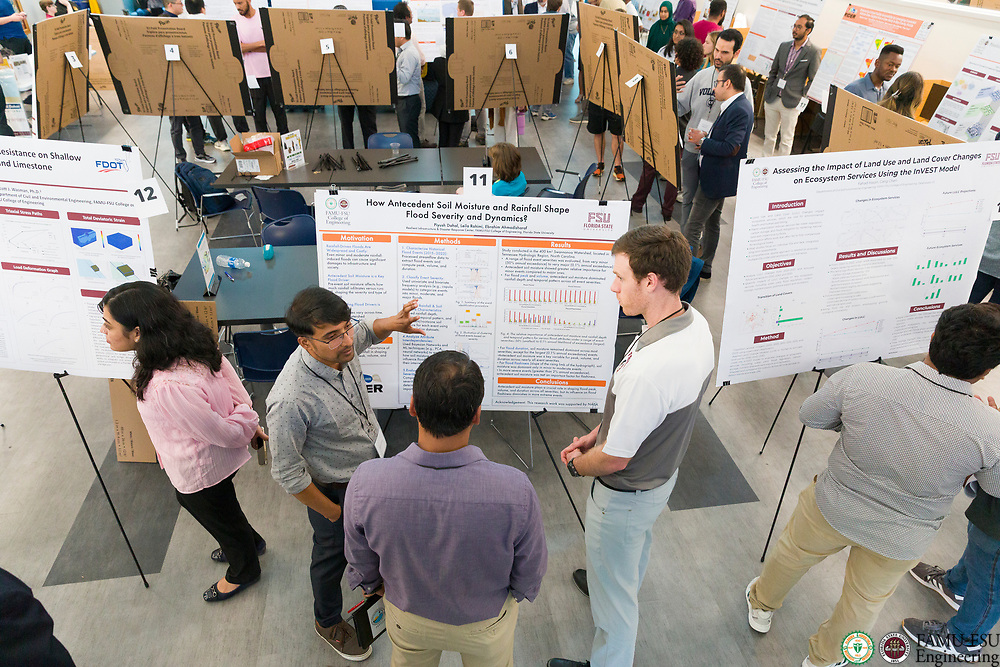
Our findings show that antecedent soil moisture consistently dominates flood peak, volume, and duration across most event severities, with its influence on flashiness diminishing only in the most extreme floods. This work, supported by NASA, underscores the critical need to include soil-moisture conditions in flood-risk models and paves the way for more accurate, resilience-focused forecasting.
Read, Watch, Listen
-
Read more: A Look Back at the U.S. Hydroclimatic Extremes of 2024In 2024, the United States confronted an extraordinary—and costly—array of hydroclimatic disasters. Across different corners of the country, communities faced floods, droughts, heatwaves, hurricanes, tornado outbreaks, winter storms, and wildfires. In total, 27 separate events each inflicted at least $1 billion in damages, resulting in $182.1 billion in losses and 568 lives lost. Torrential Floods…
—
by
Get in Touch
I welcome inquiries about research collaborations, conference talks, or consulting on hydroclimatic extremes and water-resource resilience.
✉️ Email: piyush.dahal@gmail.com
📍 Tallahassee, FL, USA
Connect with me on Google Scholar for updates on my latest work.